The future of solar energy in 2026 is no longer a distant promise — it is happening right now, in real homes, real businesses, and real power grids across the world. The future of solar energy has evolved faster in the past three years than in the previous three decades, and 2026 marks a genuine turning point for the global energy transition.
Solar panels used to be simple: heavy black rectangles doing a quiet job on rooftops. Today, they capture light from both sides, communicate with AI systems that predict tomorrow's weather, pair with affordable home batteries that keep your lights on during blackouts, and float on reservoirs generating power from water surfaces. The technology has become extraordinary — and it is more affordable than ever.
In this guide, we cover the 7 biggest solar technology trends shaping 2026 — what they are, why they matter, and how you can benefit from them right now whether you own a home, run a business, or are simply curious about where clean energy is going.
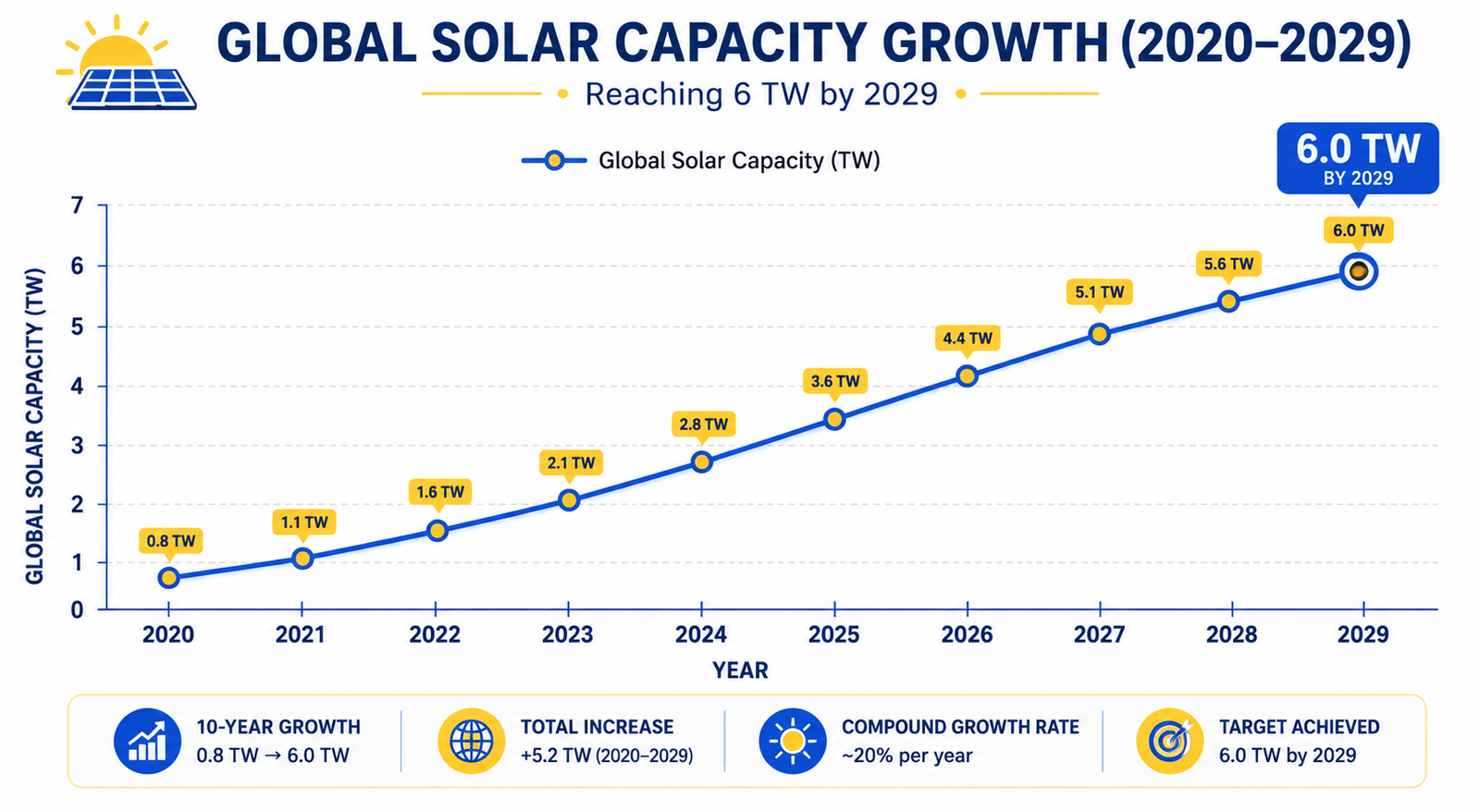
3 TW
Global solar capacity installed as of 2026
6 TW
Projected global capacity by 2029 — doubling in 3 years
33%+
Record efficiency achieved with new perovskite tandem cells
Technology 01 · Future of Solar Energy 2026
01
✦ Available Now
TOPCon Bifacial Solar Panels — The New Standard in 2026
When we talk about the future of solar energy in 2026, the conversation starts with TOPCon (Tunnel Oxide Passivated Contact) bifacial panels — the technology that has rapidly become the new industry standard for quality solar installations worldwide.
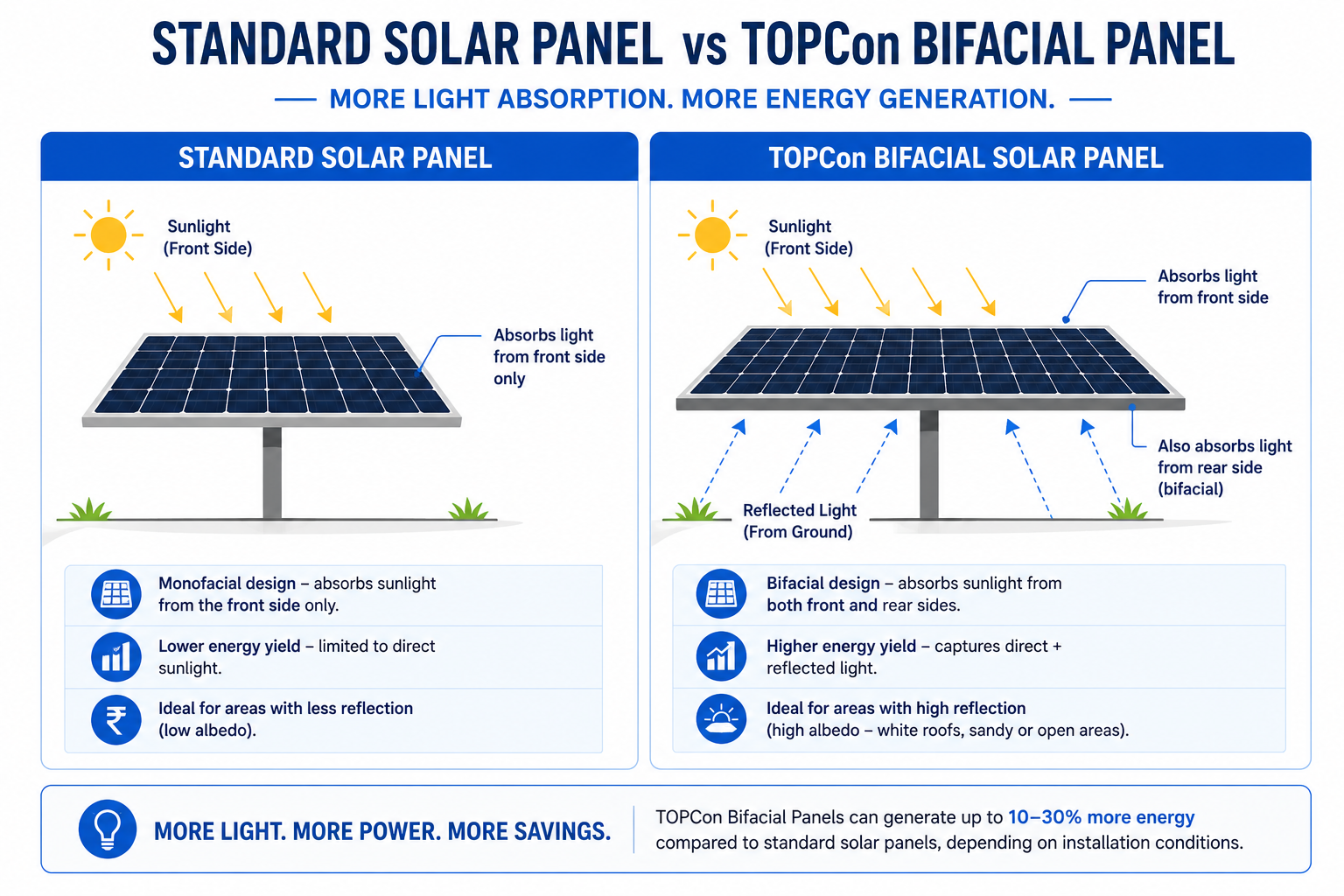
Traditional panels only capture sunlight from the front. TOPCon bifacial panels capture light from both sides — absorbing direct sunlight on the front face and reflected light from the roof surface, ground, or surrounding environment on the back face. The result is significantly more electricity from the exact same roof space.
☀️
25%
More energy than standard panels
⚡
22–24%
Panel efficiency in 2026
📅
25–30 yr
Performance warranty lifespan
🔋
730W
Output per panel, top 2026 models
A single 730W TOPCon Bifacial panel today generates what previously required two or three traditional panels — in the exact same roof space. This is not incremental progress. It is a step change.
The TOPCon design also reduces long-term degradation significantly. These panels hold their performance better over a 25–30 year lifespan, making them a superior investment for both homeowners and businesses looking at the true cost of solar energy over time. TOPCon bifacial technology is no longer a premium option — it is the new everyday standard for quality solar installations.
TOPCon bifacial panels absorb light from both faces — front and rear — significantly increasing energy output without requiring additional roof area.
Technology 02 · Solar Technology Trends 2026
02
◈ Emerging Fast
Perovskite Solar Cells — Breaking Every Efficiency Record
If TOPCon represents today's best solar technology, perovskite solar cells represent where the future of solar energy in 2026 is heading. And that future is arriving faster than anyone expected.
Traditional silicon solar cells face a theoretical efficiency ceiling of around 29%. Perovskite-silicon tandem cells shatter that barrier. In 2026, leading manufacturers including LONGi, Oxford PV, and Trina Solar are achieving 33%+ efficiency in laboratory conditions — and commercial versions are already shipping in limited quantities to select markets.
What does higher efficiency mean in practical terms? The same sized panel generates significantly more electricity. For homeowners with limited roof space, or businesses looking to maximise output per square metre, this is a genuine game changer. For the world as a whole, it means more clean energy per unit of raw material — a major sustainability win.
The primary challenge in 2026 is long-term durability — perovskite cells degrade faster than silicon under real-world conditions. However, manufacturers are solving this rapidly. Most industry experts expect perovskite tandem panels to become mainstream residential products within 2–3 years.
Every 1% improvement in solar panel efficiency translates into real money saved and real carbon that never reaches the atmosphere. The race past 40% efficiency has officially begun.
Technology 03 · Best Solar Panels 2026
03
✦ Available Now
AI-Powered Solar Energy Management — Your System Gets Smart
A solar system in 2026 is no longer just panels on a roof. The future of solar energy is an intelligent, connected system that actively thinks for itself — and AI-powered energy management is the technology making this possible right now.
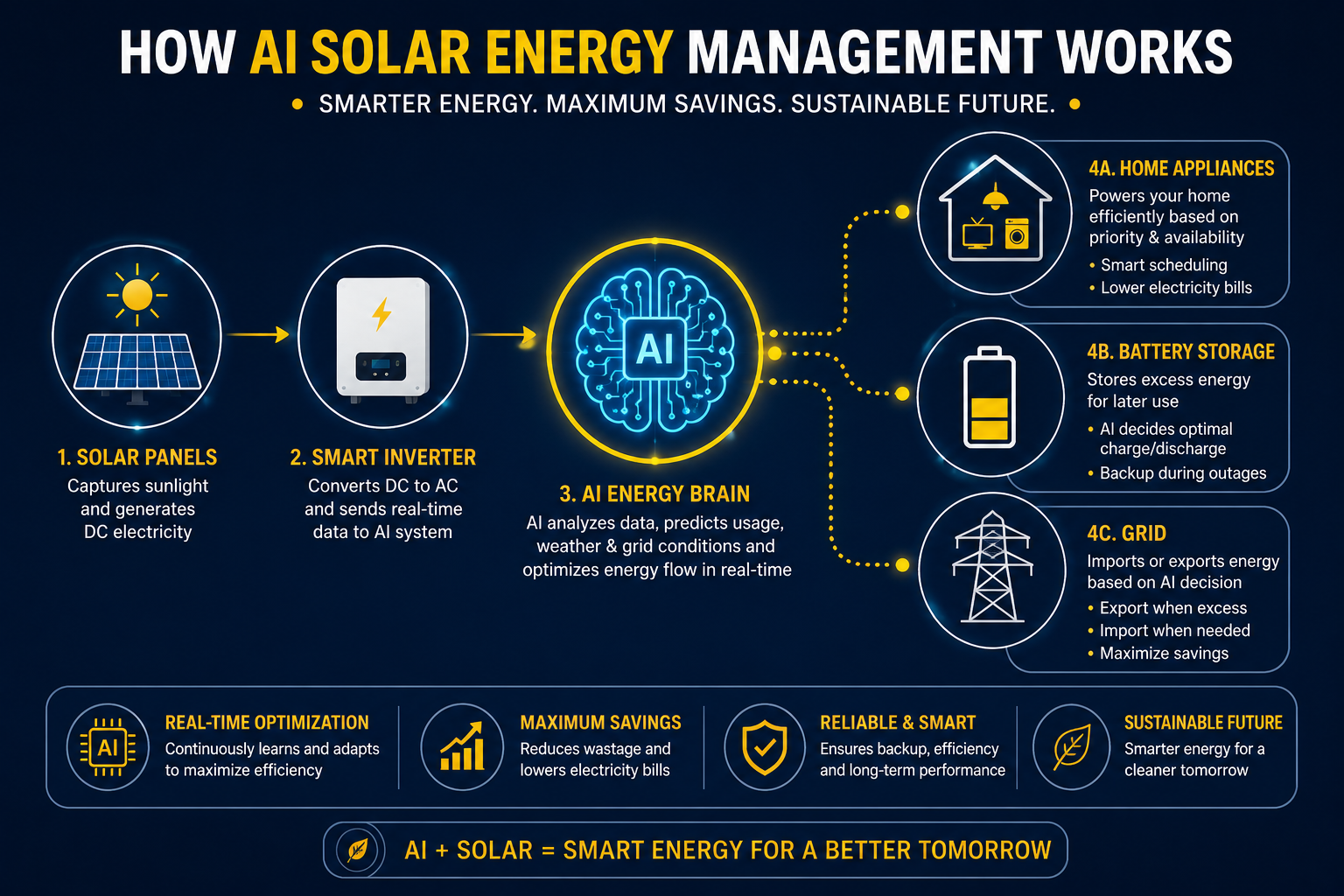
Modern AI solar management software handles tasks that would have seemed like science fiction just five years ago. It predicts tomorrow's solar output based on weather forecasts and pre-schedules your heavy appliances — washing machines, EV chargers, dishwashers — to run when solar generation is at its peak. It decides in real time whether to use solar power, draw from your battery, or pull from the grid, always choosing the cheapest and cleanest option available. And it learns your household's unique patterns over time, getting smarter every single week.
→
Weather prediction — forecasts tomorrow's solar generation and automatically adjusts your home schedule to match peak output windows.
→
Appliance scheduling — shifts high-energy tasks like EV charging and laundry to run during peak solar hours at zero grid cost.
→
Real-time optimisation — continuously chooses between solar, battery, and grid to minimise your electricity cost at every moment of the day.
→
Business peak shaving — for commercial users, AI manages demand charges by preventing grid spikes that trigger expensive tariff penalties.
For businesses, this intelligence layer can add 10–20% more savings on top of what the panels themselves already deliver. AI solar management is one of the most powerful and underappreciated developments in the future of solar energy in 2026.
AI energy management connects your solar panels, battery, home appliances, and the grid — optimising every kilowatt-hour in real time, 24 hours a day.
Technology 04 · Solar Energy Future
04
✦ Available Now
Solar + Battery Storage — The Combination That Changes Everything
For years, the most common objection to solar was simple: "What happens when the sun goes down?" In 2026, that question no longer has any weight. Home battery storage has dropped dramatically in price and is now genuinely affordable for average homeowners across the US, Europe, Australia, Canada, and beyond.
Pairing solar panels with battery storage transforms a good investment into a transformative one. Here is what that combination delivers in practice:
Energy Independence
Store solar power during daylight. Use it at night. Your home runs on sunshine around the clock.
Outage Protection
When the grid goes down, your home stays on. Fridge, lights, and work-from-home setup — all uninterrupted.
Bill Optimisation
Store cheap solar, avoid expensive peak grid rates. Time-of-use pricing stops being a problem.
Export Revenue
Sell excess stored energy back to the grid during high-price windows. Your system becomes a revenue source.
Solar without storage is good. Solar with storage is transformative. The combination delivers genuine energy independence for the first time in history — for ordinary homeowners, not just large utilities.
Technology 05 · Renewable Energy Future 2026
05
✦ Growing Rapidly
Floating Solar Farms — Generating Clean Power from Water
One of the most surprising developments in the future of solar energy is one most people have never heard of. Floating solar — solar panels installed on reservoirs, lakes, and ponds — is one of the fastest-growing formats in the global solar industry. Global floating solar capacity is projected to reach 4.8 GW in 2026, with major installations already operating across China, South Korea, the Netherlands, Singapore, and India.
→
Higher efficiency: Water keeps panels 5–10% cooler. Since heat is solar's natural enemy, this directly increases electricity output year-round.
→
No land required: Uses water surfaces that cannot be used for anything else, unlocking gigawatts of potential in land-constrained regions.
→
Water conservation: Reduces evaporation from reservoirs by up to 70% — a critical benefit in drought-affected regions across Africa, the Middle East, and southern Europe.
→
Hybrid hydro-solar: Can be co-located with hydroelectric dams to deliver reliable 24/7 renewable power — combining solar's daytime output with hydro's controllable generation.
For countries with limited land but abundant water bodies, floating solar could unlock a massive share of their renewable energy potential. It is one of the most important under-the-radar technologies shaping the future of solar energy globally.
Floating solar installations generate cleaner energy from water surfaces — benefiting from natural cooling that boosts panel efficiency by up to 10%.
Technology 06 · Solar Energy Innovation 2026
06
◈ Emerging Fast
Building-Integrated Photovoltaics — Solar Becomes Invisible
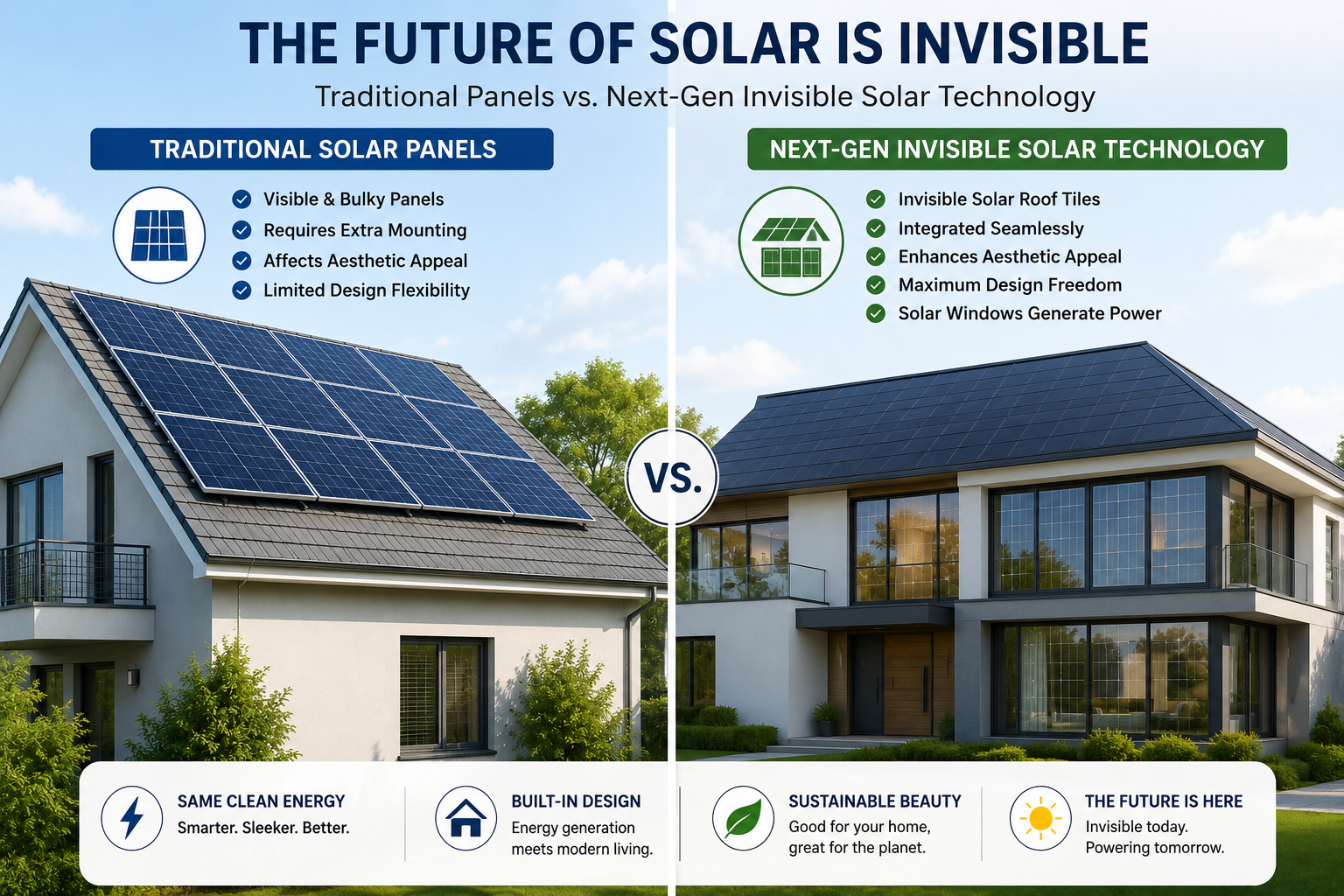
What if your roof was the solar panel? What if your office windows generated electricity while you looked through them? This is exactly what BIPV (Building-Integrated Photovoltaics) makes possible — and it is one of the most exciting dimensions of the future of solar energy in 2026.
BIPV replaces traditional building materials — roof tiles, glass facades, skylights, even walls — with surfaces that generate solar electricity. Instead of mounting panels on top of a building, the building itself becomes the power generator. The result is architecture that is both beautiful and energy-productive.
🏠
Solar Roof Tiles
Look identical to regular roof tiles. Generate electricity invisibly.
🪟
Solar Glass
Windows and skylights that generate power while staying fully transparent.
🏢
Solar Facades
Entire commercial glass curtain walls turned into urban power generators.
Across Europe and North America, BIPV is increasingly being written into building regulations for new commercial developments. Architects, developers, and city planners are recognising that the building of the future does not just consume energy — it generates it.
Technology 07 · Solar Technology Trends 2026
07
✦ Available Now
Solar VFDs for Industry — Powering Heavy Applications with Sunlight
The future of solar energy in 2026 extends far beyond residential rooftops. One of the most powerful — and most underreported — developments is the expansion of solar technology into heavy industrial applications through Solar Variable Frequency Drives (VFDs).
Industries such as agriculture, food processing, cold storage, textile manufacturing, and water treatment consume enormous amounts of electricity running motors and pumps. Solar VFDs now allow these heavy loads to run directly from solar panels during daylight hours — at near-zero electricity cost — with no changes to existing motor or pump infrastructure.
A factory running 8 hours a day on solar-powered VFDs can eliminate the majority of its electricity bill entirely — with a typical investment payback of just 2–4 years. After that, it is essentially free industrial power for decades.
This technology is mature, proven in real-world industrial deployments, and increasingly affordable in 2026. For any business operating heavy motor loads — whether in North America, Europe, Southeast Asia, or Africa — solar VFDs represent one of the highest-ROI clean energy investments currently available. Learn more about industrial solar applications at Newpious.
The Bottom Line
Where Does the Future of Solar Energy Leave Us in 2026?
The future of solar energy in 2026 is not the slow, incremental story it once was. It is a full-speed technological transformation happening across every continent, every sector, and every scale of application — from single-family homes to floating megafarms on reservoirs.
Panels are smarter, lighter, and more powerful than ever. Storage is affordable and accessible. AI makes every system more efficient. Industrial applications are unlocking the future of solar energy for factories and food processors that previously had no affordable clean energy option. The economics have never been clearer: average payback periods of 4–7 years, followed by 20+ years of dramatically reduced or eliminated energy costs.
The future of solar energy in 2026 is not a concept for the next decade. It is the present reality. The only question is whether your home, your business, or your country is ready to be part of it.
Everything You Want to Know About the Future of Solar Energy in 2026
The future of solar energy in 2026 is defined by 7 key technologies: TOPCon bifacial panels, perovskite solar cells, AI-powered energy management, solar plus battery storage, floating solar farms, building-integrated photovoltaics (BIPV), and solar VFDs for industrial applications. Global installed capacity has reached 3 TW and is projected to double to 6 TW by 2029.
TOPCon bifacial solar panels are the best-in-class technology for most residential and commercial installations in 2026. They generate up to 25% more energy than standard panels by capturing light from both front and rear surfaces, with efficiency ratings of 22–24% and 25–30 year performance warranties. For next-generation efficiency, watch perovskite-silicon tandem panels entering mainstream availability within 2–3 years.
Limited commercial perovskite-silicon tandem panels are already shipping in 2026 from manufacturers including LONGi and Oxford PV, achieving 33%+ efficiency in laboratory conditions. Mainstream residential availability is expected within 2–3 years as manufacturers resolve long-term outdoor durability challenges.
Yes — 2026 is the best time in history to invest in solar energy. Panel costs are at all-time lows, efficiency is at all-time highs, battery storage is affordable, and government incentives remain strong across most developed countries. Average payback periods in the US, UK, Europe, and Australia range from 4–7 years, followed by 20+ years of significantly reduced or eliminated electricity costs.
Floating solar systems install panels on reservoirs, lakes, and other water bodies. The water keeps panels 5–10% cooler, which directly boosts electricity output. Floating solar also reduces reservoir evaporation by up to 70% and uses land-free water surfaces — making it critical for water-stressed and land-constrained regions. Global floating solar capacity is expected to reach 4.8 GW in 2026.
This is the classic "wait for better technology" trap that costs people years of savings. The panels available today are genuinely excellent — and every year you delay is a year without reduced electricity bills. Solar technology will always continue improving, but the best time to start saving is right now with today's proven, high-efficiency systems.
Ready to Make the Switch?
The Future of Solar Energy Starts on Your Roof
At Newpious Synergies, we offer the latest TOPCon bifacial solar panels, Solar VFDs, and complete solar solutions for homes and businesses globally — with the expertise to back every installation.